
Volume I:"The Help"
— How Gentrification and Class Disparity Shape Who Gets Served.

Odd one out
I’m fine with being the stranger within my family. The gawky figure in the family portrait. The person whose seat is levelled just small enough to be mistaken for a child. The girl who’s told to eat with their mouth closed, just in case she speaks too loudly.
I’ve noticed it—the older I get, the less pleasant my company becomes. Sluggishly, I seek to please those around me. Reluctantly, I drag my feet to view upsetting principles.
In a house filled with tyrants, kings, and queens battling it out for the last word over supper, standing out is normal, accepted even.
It’s when I leave the house that the crown slips.
Leaving the sanctuary of my maple-coloured wardrobe, earthy wallpaper, and vampiric, coded sofas. The garri-stained pots and Afrobeat-injected walls (because I’m Nigerian). That is when the cracks begin to show.
Because I’ve come to realise that in the town that I live in, where I’m from, the council, those in positions of power don’t accommodate people as dark and as Black as me.
They don’t even see us.
Racism not intended.
I first noticed this when I was nineteen years old. The world was my oyster, yet my pockets were dry. I had just left a job as a waitress in the Nigerian restaurant that my dad had hooked me up with, because I am Nigerian.
If you’re African, that sentence requires no explanation.
Scrolling across the internet, my fingers landed on none other than a hospitality agency.
Now, to say that these companies are the backbone of modern Britain would be an understatement.
They don’t require much—just greasy hands and fake smiles.
By the time I clicked apply and updated my brother on our latest business venture, we had already become silent cogs in the machine.
There was a group call, filled with nearly 100 people. Then the ‘congratulations’ email was in my inbox the next day. The following week, I was in a green high-vis, scouring my local football stadium, receiving £90 in my bank account for every shift.
Everything was perfect. Nothing could upset me. Yes, there were off days, off shifts, off people—but at the end of the day, the money spoke the loudest, and turmoil was an easy price to pay.
What I didn’t expect—tingling underneath my skin like a snake shedding its coat—was the quiet discomfort that followed me in that role.
Invisible Labor
At first, I thought it was normal—natural, even—for the young, silent workforce to be made up mostly of POCs.
It was, after all, my own backyard.
Chigozie, Fatima, Sahel—names worn like tags, glued to their skins.
Adeola, Abdi, and the boys who looked like exact copies of my younger brother came in doubles. Tripled in number, into the humongous arena.
Carrying trays. Sweeping floors. Washing dishes.
Every Saturday, I’d pray—wish that my mother’s face would be spotted amongst the crowd.
So that she could catch my brother in action, foregoing his manly duties.
But I never did catch a Black face in the VIP room. Or seated in the visitors’ section.
Week after week, the stands filled with cheering spectators, while we moved quietly beneath their gaze.
Our shiny new stadium, parked on our downtrodden road, had become home to one of the biggest arenas in London.
And we became invisible.
I think that job was the first time I realised what gentrification was.
Beforehand, I thought it was a complaint—faxed by grumpy traditionalists who couldn’t fathom seeing a person of another race moving into their area.
That was until I became one of them.
Except, as I mentioned earlier, I’m not a racist.
I do, however, have eyes to see and a nose to smell. And my senses were telling me something was off—an unnatural number of chip shops, sponsored by the stadium, opening in the area. Only on football days, might I add.
There were vape shops and cafés, small markets and stalls, standing dormant until the weekend, when they would be swept up like Cinderella to the ball.
It began to hurt when I realised that nothing was really mine—even though I lived there, was raised there, took my first steps on the very concrete that strangers now trampled on.
To the council, home was a bargaining tool to gain exposure and street cred. Not something to nurture families.
Slithering through crowds of pale skin on my way back from work. As buses detoured. As people from other boroughs slipped into my small, cosy town… I admit, a part of me began to feel resentful.
Not because they did anything or said anything—but because I was uncomfortable, and they were not.
Expensive towns were being built on the other end of my borough—places they could purchase that I could hardly afford.
POC managers, POC deputy managers, and POC head chefs would rise to lead a young POC workforce—but never be the ones being served.
The unfairness of classism, and the quiet brutality of it, filled me with unease.
See, only four years earlier, my younger self had read in the local newsletter of a stadium being built in turn. The dream sold to us in small print was that it would come with a local cinema, brand new apartments, and a plethora of leisurely activities.
So the betrayal felt cruel. Unkind.
Like a dagger thrust into my teenage body—then twisted.
Reflections from “The Help”
The feeling reminds me of the 2011 film “The Help”, not in its entirety—my life has never mirrored the extreme struggles of Aibileen or the maids in Jackson, Mississippi, but in the quiet, unspoken understanding of who serves and who is served.
The film opens with Aibileen Clark, who speaks about the weight of her life and the loss of her son—a grief that settles into something like weariness.

That weariness follows her.
She moves, speaks, and exists in spaces that were never meant for her. The way she and the other maids are treated by the white families illustrates the quiet brutality of systemic inequality.
“Upsetting” doesn’t cover how the film made me feel. The imagery of control over the maids’ access to private spaces and their rushed moments of privacy was tormenting. However, their irrelevance in the rooms they serve resonated with the unease I had felt in my own work.
Importantly, my experience is not the same. I am lucky to live in a time where such overt cruelty does not govern daily life. Yet, there was one scene that felt familiar …
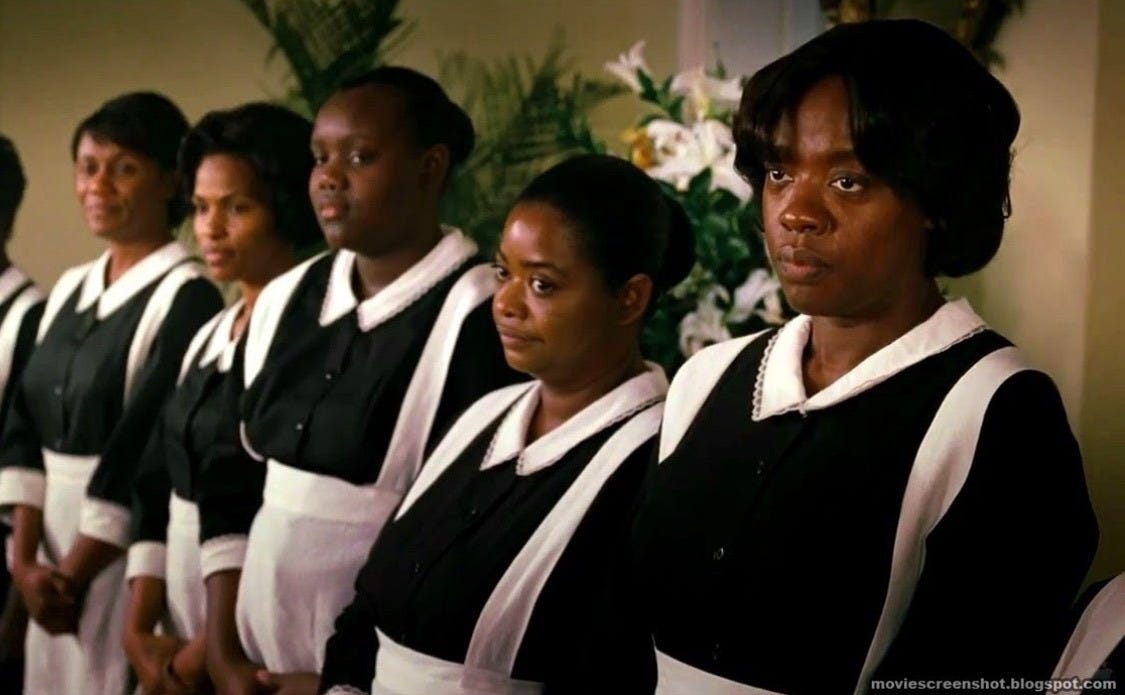
Where the maids stand at the edges of the room, dressing their mistresses in colours that were never meant for them, tending to guests they could never become.
Watching.
Serving.
Invisible.
That sense of being on the periphery, of laboring quietly while others occupied the spotlight, echoed moments I had known in my own life.
So you’re probably wondering—who’s to blame?
Is it the football fans, who just happened to be of a paler complexion than I, with easier access to doors my kinsfolk could not enter?
It can’t be them. Unlike Hilly Holbrook, they did nothing wrong.
Is it the owners of the vape shops, the chip shops, the glossy apartments built to house the rich and edge out the poor?
It can’t be them. They did what they were meant to do.
So I place the blame where it belongs—on the system.
The one that carves people into categories before they’ve even had the chance to choose who they are.
Black or white.
Rich or poor.
It makes it infinitely harder for some to climb out than others.
I blame the council that sold a dream to my teenage self—and took it back in exchange for something shinier.
They chose to please the masses, rather than invest in the people already there.
Racism isn’t just an ideology.
It’s a feeling. A pattern. A habit in society.
It shows up quietly. Knocks on doors.
Divides people into upper and lower,
… seen and unseen.
It turns belonging into distance.
And, if left unchecked, it grows.
So, don’t feed it.
Artwork that subjects POC in a successful, powerful light
If you feel like you relate to, or were unsettled by, any of the feelings explored in this essay, these films and books offer a reminder that we exist, and thrive, far beyond stereotypes and classist limitations.
Black Panther (Film)
A vision of Black excellence where wealth, technology, and leadership are the norm—not the exception—challenging narratives that tie Black identity to struggle.
Americanah (Book by Chimamanda Ngozi Adichie)
Follows a Nigerian woman navigating race, identity, and success across continents, revealing how class mobility is shaped by environment and perception.Slumdog Millionaire (Film)
A young man rises from poverty in Mumbai, exposing the rigidity of class systems while showing that knowledge and resilience can disrupt them.Crazy Rich Asians (Film)
Showcases Asian wealth, legacy, and elite society, normalising opulence within a POC context often missing from mainstream narratives.The Other Black Girl (Book by Zakiya Dalila Harris)
Explores Black success in corporate spaces, highlighting how race continues to shape experience even within upward mobility.The Pursuit of Happyness (Film)
A story of perseverance and ambition, tracing a Black man’s journey from homelessness to financial stability against systemic odds.
Premiering Next Week On ‘Eliad’; the last of Volume I.
If you have an essay or piece of artwork that relates to next week’s themes, please share a link to your Substack post by sending me a direct message on Substack.
All submissions must be received by Monday at 1:00 PM (GMT).
Selected contributions will be featured in Volume I, with full credit given to the creators.
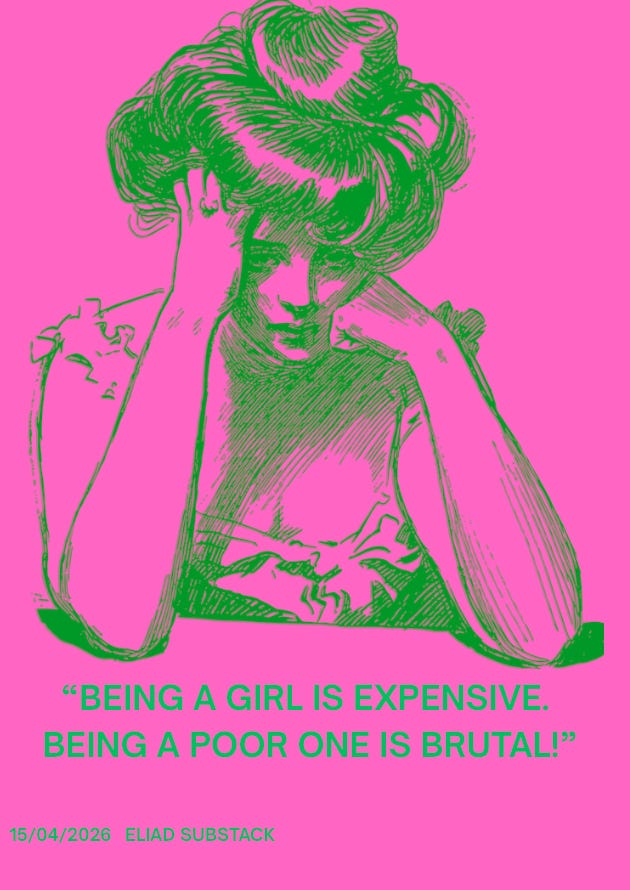
Here’s are the themes:
The Cost of Girlhood
How femininity comes with financial, social, and emotional burdens, making beauty and style a classed experience.
Capitalism and Self-Worth
How societal and consumer pressures train women to maintain appearances, linking identity and value to spending.
Class and Opportunity
How poverty shapes experiences, access, and social validation, creating inequality between “rich” and “poor” girls.
Redefining Femininity
Encouraging future generations to value internal beauty, self-worth, and personal growth over transactional, external appearances.
Eliad Essays | “The Help” | © 2026
Thank you so much for highlighting this! I have something in the works which may peek your interest with some similar themes✨ such an important topic and very well written✨going to restack this!🍓💕🌸
Wow thanks so much angel I’m so glad u like it!!😇🙏
It’s a bit of a heavier essay so I was a bit nervous to share it tbh.
But yes if you have any work related to next week’s themes then my DM is always open, I’d just need it sent to me by Monday at 1pm GMT so I can pull out some quotes from it or interweave the artwork into the final essay.
If the post aligns with the essays themes I’ll try and find a way to reference it in next week’s essay and all credits would of course go straight to you!
Thanks for sharing my work and for being so supportive. God bless 💝❤️✨